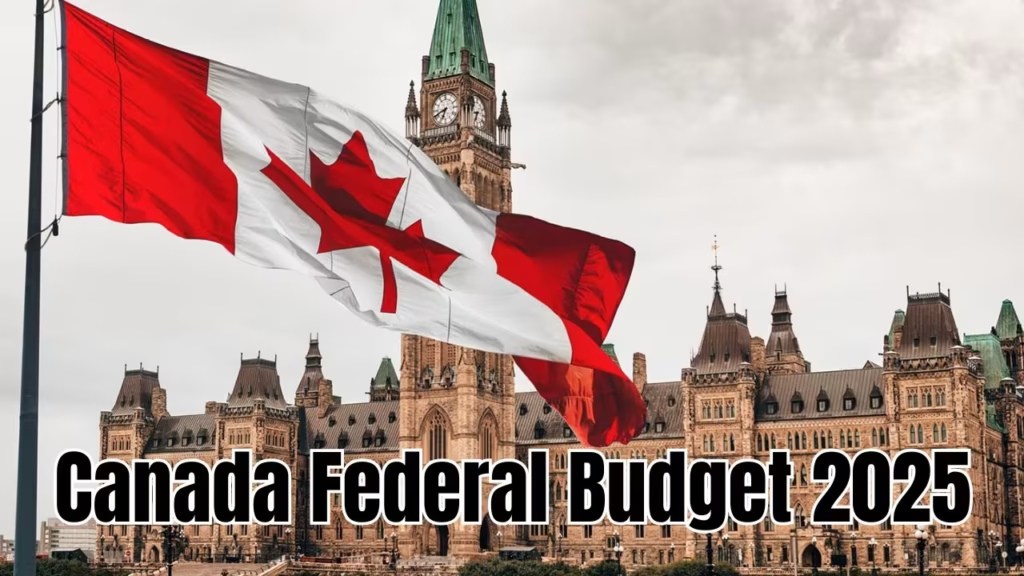
Canada Federal Budget 2025: On November 4, 2025, Finance Minister François-Philippe Champagne presented Canada’s Federal Budget 2025, the first budget under Prime Minister Mark Carney. It has been described as both an austerity and investment budget. This ambitious fiscal plan tries to balance careful spending with smart investments meant to support workers, spark innovation, and encourage sustainable growth amid global uncertainty. With a stronger focus on affordability, infrastructure, and advanced technology, Canada aims to build resilience and prosperity for all its citizens.
Canada’s new government took a careful approach in Budget 2025. It prioritized important investments in key areas while showing fiscal responsibility through targeted savings and efficient operations. The budget introduces a new model that aims to spend less on government operations while investing more in initiatives with long-term economic benefits.
Investment in Canadian Workforce and Skills Development
One of the budget’s main goals is to empower Canadian workers. Budget 2025 sets aside $97 million over five years for a Foreign Credential Recognition Action Fund. This will make it easier for immigrants to have their qualifications recognized and successfully enter the labor market. The Union Training and Innovation Program will also be expanded to enhance apprenticeship training in Red Seal trades, which is crucial for building new infrastructure and the millions of homes planned across Canada.
Personal support workers receive special attention through a temporary five-year Personal Support Workers Tax Credit, offering eligible workers a refundable tax credit of up to $1,100 annually. This measure recognizes their important role and aims to improve wage support in provinces without existing agreements in place.
Housing and Infrastructure
To tackle the housing crisis, Budget 2025 allocates significant funding for the Build Canada Homes agency, starting with $13 billion to speed up home construction. Acknowledging years of underinvestment, the government commits to large infrastructure projects, including investments to expand clean and conventional energy infrastructure to help Canada become a global energy leader.
Innovation and Technological Advancement
Budget 2025 focuses on boosting Canada’s productivity through innovation and technology. New tax measures for research and development (R&D) are introduced, including an improved Scientific Research and Experimental Development (SR&ED) Tax Incentive Program, which raises the refundable credit expenditure limit to $4.5 million. Furthermore, discussions on a patent box regime aim to promote intellectual property development in Canada by offering lower tax rates on income from qualifying patents.
The budget also includes plans for a 20% Artificial Intelligence (AI) deployment tax credit for small and medium-sized businesses that adopt qualifying AI technologies. This supports Canada’s goal of becoming a leader in advanced manufacturing, biotechnology, and quantum computing.
Environmental Commitment
Canada’s dedication to tackling climate change and promoting a green economy is strong. Budget 2025 increases investment tax credits for clean technology, clean electricity, clean hydrogen, electric vehicle supply chains, and carbon capture, utilization, and storage (CCUS). A new $370 million incentive will boost biofuel production, supporting Canadian agriculture and canola producers affected by trade tariffs.
Fiscal Outlook and Deficit Management
While Budget 2025 projects a deficit of around $40 billion, it aims to control deficit growth through operational savings and a spending review, seeking efficiency without cutting crucial investments. The government expects that focusing public spending on strategic investments will encourage economic growth over time, increasing revenue to address short-term costs. The debt-to-GDP ratio is expected to stabilize, reflecting a careful but growth-focused fiscal approach.
Canada’s Federal Budget 2025 marks an important moment with a bold yet cautious approach that balances austerity with transformative investments. By focusing on workforce empowerment, addressing the housing crisis, fostering innovation, and supporting a green economy transition, the government aims to create a strong foundation for sustainable economic growth in a rapidly changing world.
FAQ’s About Canada Federal Budget 2025
What are the main goals of Canada’s Federal Budget 2025?
The main goals are to empower Canadian workers, invest in infrastructure and housing, promote innovation and green technology, and manage deficits responsibly while stimulating economic growth.
How does the budget address the housing crisis?
Budget 2025 allocates an initial $13 billion to accelerate home building through the Build Canada Homes agency, with plans for millions of new homes to address affordability and supply shortages.
What support is provided to workers in Budget 2025?
The budget includes expanded apprenticeship training, a tax credit of up to $1,100 for personal support workers, and initiatives to improve recognition of foreign credentials to facilitate workforce participation.
Are there any new tax incentives for businesses?
Yes, including enhancements to the SR&ED tax credit, proposed patent box tax regimes, and a new 20% AI deployment tax credit for eligible small and medium-sized businesses.
What is the fiscal outlook following this budget?
The government anticipates a deficit around $40 billion but plans to reduce future deficits through operational savings and economic growth fostered by strategic investments.
How does the budget support environmental sustainability?
It expands investment tax credits for clean technologies and introduces a $370 million biofuel incentive to foster green energy and reduce carbon emissions.