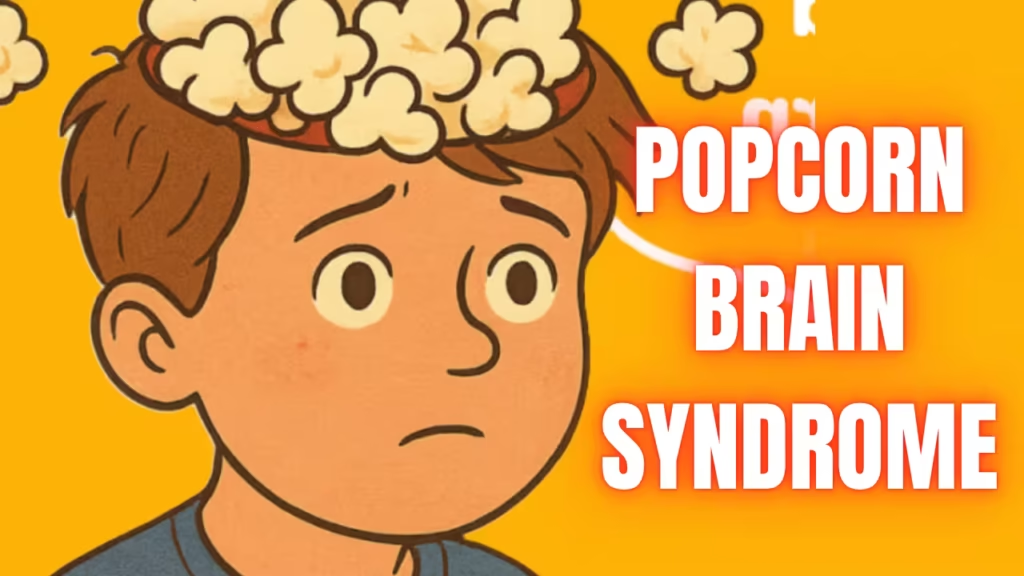
Popcorn Brain Syndrome Increasing in Indian Youths: Experts Threaten with Digital Overload. The advertisements, game notifications, reels, and news are all contending to get your attention. However, what happens when this is the new norm to your brain? According to the doctors, this continuous stimulation has led to more and more mental disorder among Indian teenagers which is known as the Popcorn Brain Syndrome.
In colleges, schools, and even in work places, children are struggling to concentrate on a single task at a time. According to experts, the constant overstimulation of the brain brought about by mobile phone usage, social media, and gaming made brains impatient, alert, and restless 24 hours round the clock like the popcorn popping in a pan.
What is Popcorn Brain Syndrome?
The concept of Popcorn Brain was originally coined by a scholar at the University of Washington, David Levy in 2011. It refers to a hyper-stimulated state, in which the brain of a person is in a constant search of something new and fast information. The name fits perfectly. We also are like popcorn in a hot pan we cannot help but jump to another app one after another, screen to screen without ever stopping.
The health professionals elaborate that Popcorn Brain is primarily a loss of attention and inability to focus due to excessive screen time. It is not a disease as such but has definite mental and physical outcomes. To put it bluntly, it implies that your brain is accustomed to the rapid digital stimulation and thus ordinary life starts to seem slow and humdrum.
Latest Update- Popcorn Brain Syndrome
As reported recently, digital balance is a set of programs being launched by a number of tech startups and platforms in India that focus on mental wellness. Certain mobile applications contain “mind break notifications” that make a user aware when he spends excessive time scrolling.
In Delhi and Maharashtra, education boards also consider new modules in schools to educate students in mindful levels of screen usage. Meanwhile, medical professionals highlight that Popcorn Brain is not a disease, but it may become a serious problem to the population, in case it is ignored.
O-1 Visa 2025 Eligibility, Application Process, Fees, Processing Time & USCIS Guidelines
$1550 Stimulus Check 2025 Eligibility, Payment Dates & IRS Deposit Update
What’s Causing Popcorn Brain Syndrome in Indian Teenagers?
Indian young people are one of the leading users of internet in the world. Digital devices have become their best friends ever since school work to online games. Although this has been a technological change that has made life easier, it has overworked the youthful brains. This condition is being fuelled by a number of reasons:
Prolonged screen time – Hours on social media and gaming eliminate the capacity to remain dedicated to slow or tranquil things such as reading or studying.
Instagram gratification – Each like, share, and notification triggers the release of dopamine, the happy chemical, in the brain. Gradually, this rush becomes more desired by the users, and the offline life is tedious.
Constant notifications – New notifications in the apps keep on jumping to distract the brain and make it restart focusing, which tires the brain.
Multitasking – It involves doing two or more things at once, e.g., watching a video and texting or working at the same time, and confuses the brain so that it can no longer process information at a deeper level.
These habits gradually alter the brain functioning when followed every day, such that it is difficult to focus even on minor tasks.
Who is Most Affected?
Although initially it was observed in the teens, it was later discovered that similar symptoms are being exhibited by individuals aged between 30 and 45 years also by the doctors. Digital dependence is no longer an issue that is only common among teens, even those who work remotely and adults who spend a lot of time online working and entertainment are not an exception.
Nevertheless, the teens are the most exposed since their brain is still growing and is more prone to the stimulus, and once they get used to it, it becomes difficult to reduce it as they grow. Psychiatrists in the cities where access to gadgets and internet is now a right report that there are more (physically) visible young patients in the cities complaining of short attention, lack of patience, stress, or anxiety than before the pandemic.
Signs of Popcorn Brain
It is significant to identify Popcorn Brain Syndrome at an early stage. Physicians explain that children and adolescents tend to exhibit symptoms without the understanding of their severity. Common symptoms include:
- Also being anxious or frustrated when not using the phone.
- Difficult to concentrate on a single thing.
- Restless mind, even when free.
- Feeling anxious about being out of the online game.
- Insomnia or persistent fatigue.
- No longer interested in outdoor or face-to-face communication.
Experiential: Demoralized by miscellaneous work. When such habits are not controlled, it may be detrimental to productivity, academics and even the mental state.
When Will SNAP Benefits Resume? Senate’s Vote Could End the US Shutdown Deadlock
Impact of Digital Overload on the brain?
Human brain is not designed to take so much digital noise. Previously, there were limited activities that people were concerned with. Nowadays, our brains alternate between notifications, posts, messages, and short videos every single minute. This fast-paced way of living does not give the mind the time to rest or contemplate intensely thus leading to some of the long term alterations like:
- Decreased memory retention
- Shortened attention span
- Mental fatigue
- Inability to converse in real life
- Poor creativity and problem solving
- Physicians liken it to a muscle which is not rested after overwork, but instead, weakens instead of getting strong
The distinction between Popcorn Brain and Internet Addiction
Popcorn Brain is not completely equivalent to internet addiction. Internet addiction refers to the inability to be offline longer than two hours whereas Popcorn Brain refers to the ability to be functional but always wanting the mental stimulation. You do not have to be online constantly but your head still desires to alternate thoughts and duties in an instant. To put it short, your body may be on rest, but your mind continues to scroll. Both, nevertheless, may result in certain mental disorders, including anxiety, depression, and sleep disorders.
Easy Droogs To Beating Popcorn Brain
You do not have to give up the digital world. Rather, when it comes to small or conscious actions, there can be a lot of improvement. Experts in mental health recommend developing a sense of control over screen time, which cannot rely on the power of self-discipline. The following are easy, useful methods of beginning to reverse Popcorn Brain Syndrome:
Take 10 minutes each day and concentrate on your breath or environment. This helps to concentrate slowly and reduce the speed of thought. Do not multitask but work on single activity at a time. Do one job thoroughly before the next one. Disabling superfluous social media notifications when you are working or studying is a good idea. No less than one no-screen hour a day–particularly before sleep. This period may be used to read or walk or communicate with family.
Keep bedrooms and dining rooms offline in order to restore normal family conversation. Practice yoga or meditation,
Padmasana and Pranayama are yoga poses that are used to relax the mind and expand attention. Make brief breaks within long study or work periods to get the thoughts out of your head. Check the time you spend online and decrease it gradually with the help of built-in phone tools. Play more outdoors, meet your friends face-to-face or train offline Parents may establish screen-time limits and encourage a hobby, such as drawing, music, or sports. To create awareness of digital hygiene, Indian psychiatrists and counsellors are now requesting people to carry out campaigns to sensitize the population. Schools are now starting to have sessions on healthy online habits and even colleges are promoting off-line reading time.
Recently the Indian Council of Medical Research (ICMR) observed that the children screen time among children between 12 and 18 years old has increased by almost 60 percent since 2020. As the smartphone population in India is now over one billion, experts believe that behavioural and mental health services should now be accompanied by digital access.